Ultimate Guide to Diagnostic Freeze Spray
Diagnosing and repairing electronics can be painstaking and sometimes frustrating work. Problems can be intermittent, and the faulty area difficult to locate on the PCB. Freeze spray is an essential tool, because it helps identify faulty components, solder joints, and other problems that can lead to board failure.
What is Freeze Spray & What is it Used For?
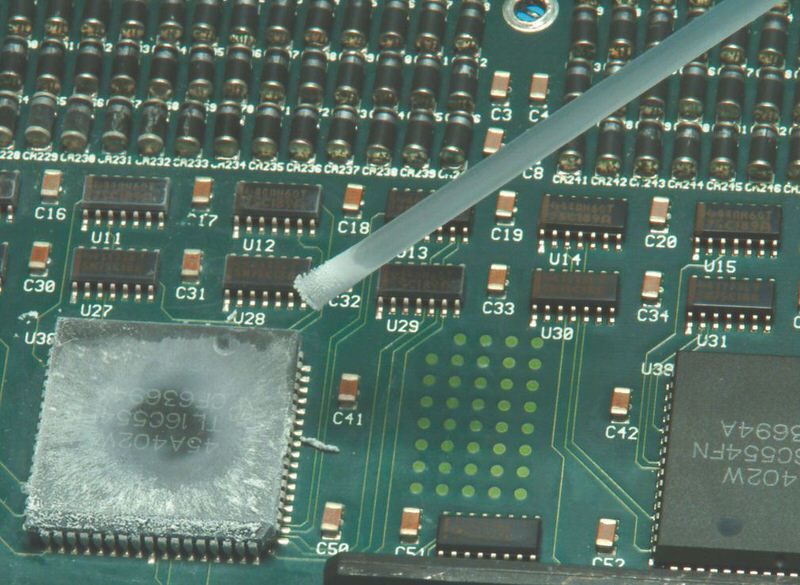
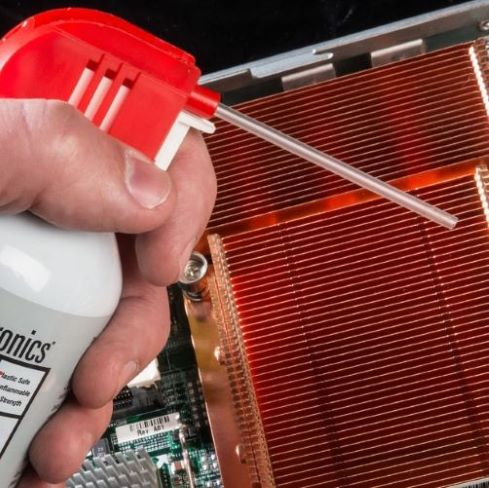
Freeze spray (also called freezer and circuit chiller) is an aerosol spray that is engineered for locating intermittently faulty electrical and electronic components and for cooling printed circuit boards. Freeze spray is nonflammable, residue-free and provides fast cooling action that super-chills isolated areas.
It is used as a troubleshooting aid for intermittently faulting capacitors, resistors, semiconductors, and other defective components. Freezer also increases the visibility of cold solder joints, cracks in printed circuit boards and oxidized junctions. Chemtronics® line of freeze spray is exceptionally pure, nonflammable, and provides instantaneous freezing action while leaving no residue.
Conveniently packaged and designed for either pinpoint or full board application, these non-reactive circuit refrigerants evaporate instantly while cooling targeted areas. They are commonly used to:
- Test electronic equipment for and to locate thermal intermittent components and systems.
- Test electronic components.
- Provide heat sink protection for heat-sensitive components during soldering and desoldering.
- Perform low-temperature testing of prototype circuitry and electromechanical systems.
- Locate hairline cracks in stressed traces of PC board.
- Freeze adhesives or gum for quick removal.
How Do You Use Freeze Spray for PCB Diagnostics?
For most PCB diagnostic work, freeze spray operates on the principal that areas of the PCB, solder joints, and faulty components with high resistance or a short tend to generate heat. Of course, this diagnostic method isn’t as helpful around components that are naturally heat generating, like ICs.
The Standard 3-Step Diagnostic Method:
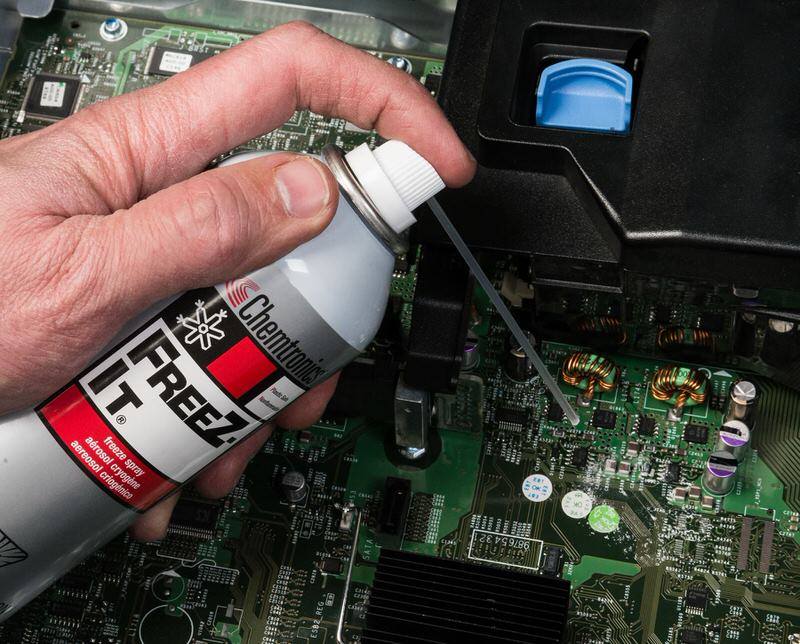
- Spray over PCB: Saturate the suspect area of the energized circuit board with freeze spray.

- Allow frost to collect: Wait several seconds for the saturated area to draw in ambient moisture and frost up. To accelerate that process, spray it with regular canned air, or the same can of freeze spray held upside-down (which would expel air and not refrigerant).
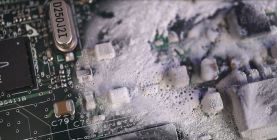
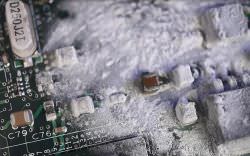
- Watch thaw pattern: Observe the frosted area of the PCB carefully, watching out for areas that thaw sooner than the rest. The warmer area indicates higher resistance or a short.
Techniques for Specific Failures:
- Overheating Devices: For a device that is over-heating (stops functioning after a period of time), spray specific areas of the PCB until the device starts functioning again. That cools the component at fault, and identifies their position.
- Questionable Solder Joints: When testing for questionable solder joints (perhaps an inadequate metallurgic bond), spray isolated areas of the live PCB until it stops functioning. The thermal shock of the refrigerant will tend to break loose a bad (or “cold”) or brittle solder joint, creating a catastrophic failure that could now be fixed.
What is Inside Freeze Spray?
Freeze sprays only include nonflammable refrigerants, because the typical application is on live circuitry. A small amount of solvent, like methanol or isopropyl alcohol, is sometimes added to dissipate static charge. This allows the freeze spray to be used on static-sensitive electronics.
Commercially available freeze sprays come in one of two main varieties:
| Refrigerant Type | Chemical Name | Description & Environmental Impact |
| HFC-134a | 1,1,1,2-Tetrafluoroethane | The same material generally used in modern air conditioning systems. It is nonflammable, making it popular in professional or industrial applications because it can be sprayed on energized circuits. It has a Global Warming Potential (GWP) of 1400 (1400 times the impact of CO2), but is not considered a VOC, so it does not contribute to smog. |
| HFO-1234ze | trans- 1,3,3,3-Tetrafluoropropene | A newer technology that is nonflammable (under ambient conditions) and has a very low GWP of less than 1, so below the global warming impact of CO2. This is far below HFC-134a and still has the advantage of being VOC-free. Because it is a newer technology, it is relatively expensive compared to older alternatives, though prices are expected to decrease as usage increases. |
Freeze Spray vs. Canned Air
As many technicians have noticed, canned air (also called “duster”) and freeze spray are closely related. Both contain 100% (slightly less in anti-static freeze spray) refrigerant/propellant. The difference is the can itself.
- Freeze Spray: Freeze spray cans have a dip tube that reaches the bottom of the can to spray liquid refrigerant.
- Canned Air (Duster): Duster cans do not have a dip tube that reaches the liquid in the can, so they spray only vapor. If you turn a can of duster upside-down, you basically have a freeze spray (albeit an awkward one to handle).
Caution: Bear in mind that commercially available freeze sprays are all non-flammable because they are intended to spray on live circuitry. Many dusters have flammable refrigerants, so be careful not to spray duster upside-down (as expedient freezer) on live circuits without first checking the ingredients’ flammability rating.
Specialty Formulations & Delivery Systems
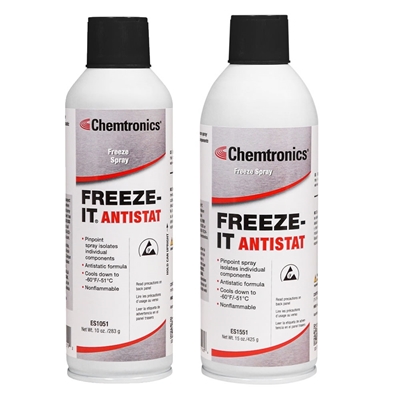
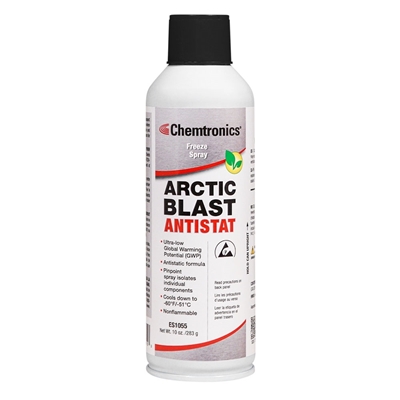
Freeze Spray for Static-Sensitive Electronics Yes, freeze spray can generate a static charge, and yes, we have solutions. The liquid refrigerant spraying from a can of freeze spray tends to generate a static charge, which can be problematic if spraying static-sensitive components and devices. If a plastic straw and spray head is also involved, they can become charged in the process. Grounding with a strap and alligator clip won’t help on the plastic parts of the freeze spray packaging. Chemtronics offers Freeze-It Antistatic (HFC-134a based) and Arctic Blast Antistatic (HFO-1234ze based) freeze sprays for performing diagnostic work on static-sensitive components and devices. They contain a small amount of alcohol that dissipates static and prevents it from building up.
Freeze Spray for Microelectronics vs. Large Areas Chemtronics freeze spray also comes with the option of a pin-point, high precision sprayer to locate problems in a tight area or a broad spray head for freezing larger areas at one time.
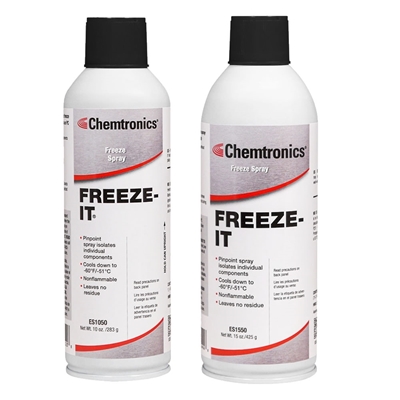
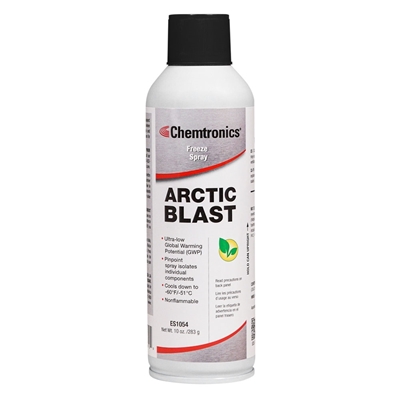
- Pin-point Sprayers: Freeze-It (HFC-134a based) and Arctic Blast (HFO-1234ze based) freeze sprays offer pin-point sprayers, which provides finer control over how much refrigerant is applied and where. This feature is unique to the Chemtronics brand and is ideal for microelectronics.
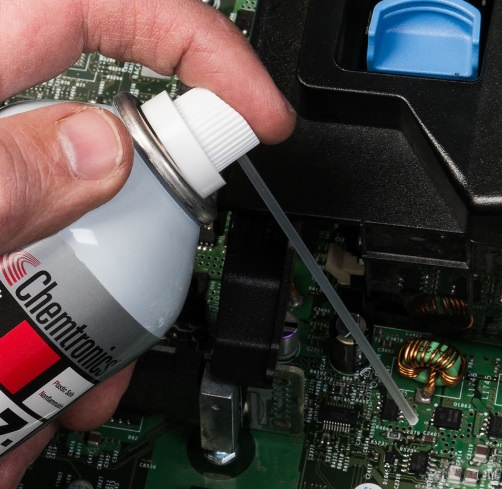
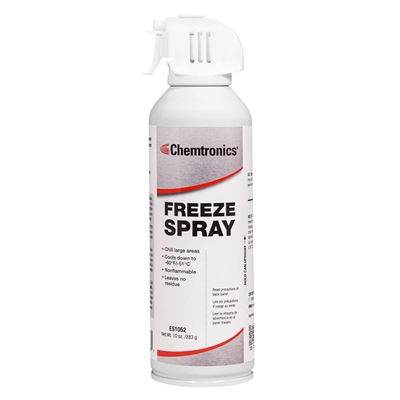
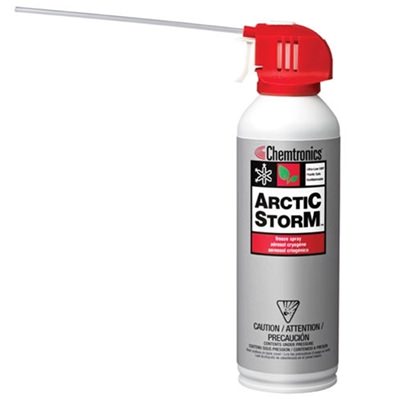
- Broad Sprayers: The broader sprayer used for Freeze Spray (HFC-134a based) and Arctic Storm (HFO-1234ze) branded circuit chillers expel refrigerant at a faster rate and over a wider area, so they are better for diagnosing problems over a larger PCB or device.
Frequently Asked Questions (FAQs)
Q: How cold is freeze spray?
A: The temperature of freeze spray is generally stated as the boiling point of the contents. While the refrigerant exits the aerosol can at its boiling point (between -40°F/-40°C and -60°F/-51°C depending on the contents), that’s not what is actually hitting the PCB. The split-second the refrigerant liquid hits a warmer surface, it boils off the excess energy (heat). The temperature rises quickly, and by the time you see a nice build-up of frost, you are roughly at the freezing point of water (-32°F/0°C).
Q: Why not use liquid nitrogen for diagnostic freeze spray?
A: Liquid nitrogen has a boiling point of -320°F/196°C, much lower than your typical aerosol freeze spray (-60°F/-51°C). Unless you know what you are doing, there is a much greater chance of over-stressing the PCB. In addition, it takes a lot of energy to run a vacuum chamber and pump to maintain a stable supply of liquid nitrogen. If the storage unit isn’t well maintained, the results can be explosive.
Q: Does freeze spray hurt the ozone layer?
A: No, this is a misconception based on old information. Freeze spray contained CFCs (chlorofluorocarbon) over 20 years ago, but have since been replaced with materials that do not impact the ozone layer. In North America, there are no commercially available aerosols that contain ozone-depleting propellants.
Q: Is there freeze spray that is safer for the environment?
A: Chemtronics offers Arctic Blast and Arctic Storm freeze sprays, which contain HFO-1234ze. HFO-1234ze is nonflammable (under ambient conditions) and has a very low GWP of less than 1, so below the global warming impact of CO2.
Need Help? Contact us at 770-424-4888 or [email protected] and we can help you find the best freeze spray for your requirements.
Ask A Technical Question
Stay up-to-date on Chemtronics news, products, videos & more.
Related Products