Ultimate Guide to Ultrasonic Cleaning
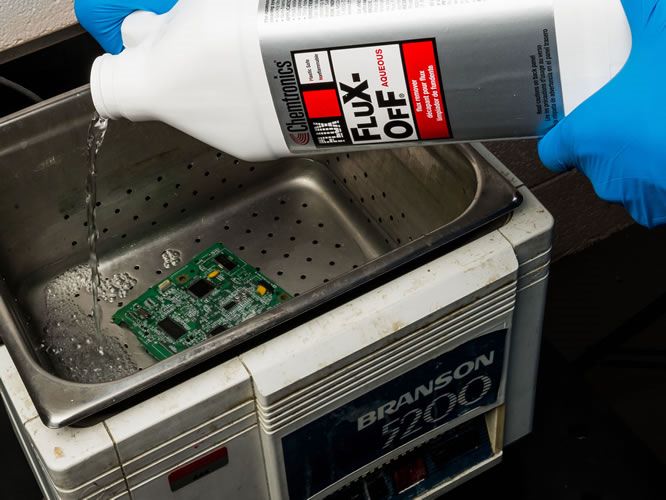
Cleaning with a combination of a solvent and ultrasonic cleaning equipment is a popular choice when companies in heavy industry, electronics, medical electronics and aerospace industries need to aggressively remove stubborn soils. An ultrasonic cleaning process utilizes equipment to transmit ultrasound waves to break apart fluxes, heavy greases, waxy corrosion inhibitors, and other challenging contamination. Those soils will then flow off the parts and into the cleaning solution.
Ultrasonic equipment varies widely in power and size from small benchtop units, like you find in jewelry stores, to large industrial models. Units have a tank or chamber that holds the liquid cleaner and transducers that transmit sound waves into the chamber. Parts can be placed directly into the chamber, or contained in a basket to make it easier to submerge and remove smaller components.
How Does Ultrasonic Equipment Work?
An ultrasonic cleaning process utilizes equipment to transmit ultrasound waves, generally between 20-40 kHZ. The transducers send sound waves through the liquid cleaner, which acts as a transfer medium from the transducers to the parts.
- Acoustic Streaming: At very high frequency, the waves pass over the surface of the parts creating agitation through a process called acoustic streaming.
- Cavitation: Lower frequencies create cavitation within the liquid. These voids quickly collapse, generating heat and shock waves, which creates agitation in the cleaning process.
Disadvantages & Risks of Ultrasonic Cleaning
Ultrasonic cleaning has the potential to cause damage to delicate parts and surfaces. For electronics, these would be ceramic-based components while for micro-electromechanical systems (MEMS) it is gyroscopes, accelerometers or microphones that are of particular concern.
Another potential problem with ultrasonic cleaning is cross-contamination. When the soil breaks down and flows off the part, it contaminates the solvent, creating the possibility that the dissolved soil will redeposit onto the next part(s) to be cleaned. Cross-contamination can be reduced with a final rinse in virgin solvent or a pass through the vapor zone of a vapor degreaser.
Frequency Impact on Parts & Cleaning Power
It is helpful to think of the frequency range like coarse-grade sandpaper (low frequency) versus fine sandpaper (high frequency).
| Frequency Range | Cleaning Action & Cavitation | Risk to Components |
| Lower Frequency | Cavitation bubbles are larger and transfer more energy to the soil. Coarse sandpaper effect makes faster work of removing material. | Can lead to more aggressive cleaning, but can also damage sensitive parts and surfaces. |
| Higher Frequency | Smaller cavitation bubbles can penetrate into tighter surface areas. The cleaning action may not be as aggressive, so higher temperatures or more time may be needed for adequate cleaning. | Less likely to cause damage to delicate parts. |
How to Maximize Cleaning Performance
Several adjustments can be made to increase the cleaning performance of your ultrasonic process:
- Chemistry: If the chemistry has a good solvency match to the soil, less sonic agitation will be needed. This allows you to run your cleaning process more quickly, at lower temperatures and lower amplitudes, decreasing the likelihood of damaging sensitive components.
- Temperature: Increased temperature generally improves the cleaning performance of a solvent. Higher temperatures can also reduce the viscosity of the cleaner and increase the surface tension, allowing the solvent to enter tighter areas. Cleaning performance increases significantly if the temperature of the solvent is above the melting point of the soil.
- Amplitude: This is the height of the wave, or the loudness. Greater amplitude will generally increase cleaning effectiveness, but also the potential for damage to delicate surfaces or components.
- Frequency: This is the number of waves in a second, so how "tight" the wave form is. High frequency sonic waves can penetrate into tighter areas. As you get over 400 kHz, in the mega-sonic range, the bubble collapse is not as violent due to smaller spacing, so cleaning is often less effective in tight areas.
- Time: Increase the time of the cleaning cycle to compensate for lower than optimal solvency.
Selecting the Best Cleaning Solvent
If the chemistry is a good solvency match to the soil, less sonic agitation will be needed. The following are characteristics to look for when reviewing options:
- Solvency: Ability of the cleaner to breakdown and dissolve the soil. For a quick evaluation, place a drop of cleaner directly on the soiled part, let it sit for a few minutes, and then blot it dry to see if it wets and breaks down the soil.
- Surface Tension: This impacts how well a solvent can get into tight crevices, like under low stand-off components.
- Density: Density can have a minor impact on how quickly the sonic waves travel through the liquid, and the amount of cavitation. A higher density material requires more energy to move, so could deplete the energy, thus the cleaning power, by the time it reaches the part.
- Flammability: Narrow your selection down to a nonflammable cleaner to prevent flammable vapors from accumulating or propagating.
- Toxicity: Ensure solvents are safer alternatives to the four most common industrial solvents: trichloroethylene (TCE), n-propyle bromide (nPB), perchloroethylene (perc) and Methylene Chloride.
- Environmental Issues: Check state (e.g., CARB), municipal, and industry-specific regulations that restrict the use of high VOC (smog-contributing) or high GWP (global warming) materials.
Chemtronics Ultrasonic Cleaners
No Chemtronics ultrasonic cleaners contain highly toxic solvents. Options include:
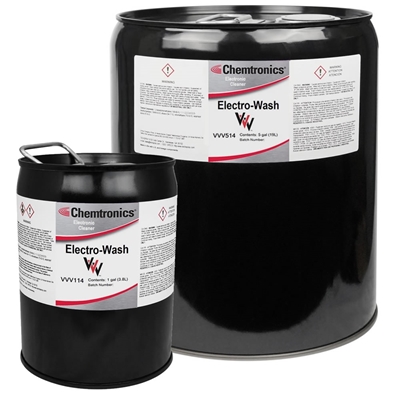
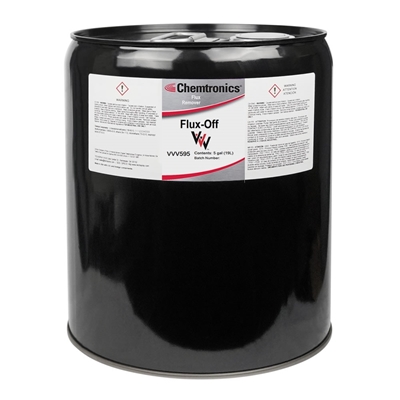
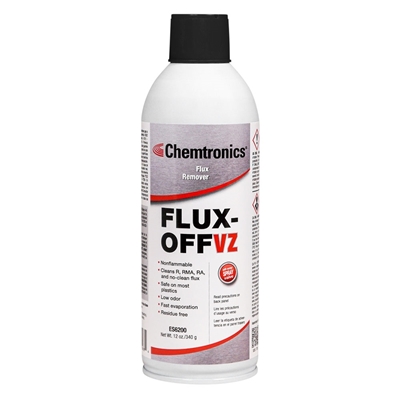
- Electro-Wash Tri-V and Flux-Off Tri-V High Performance Cleaners: Nonflammable solvents engineered to replace toxic solvents like nPB and TCE that quickly remove flux, grease, oils, dirt, dust, and other contaminants.
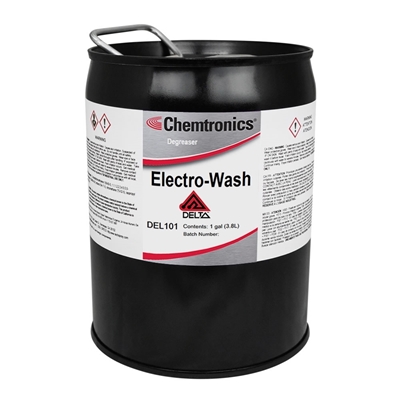
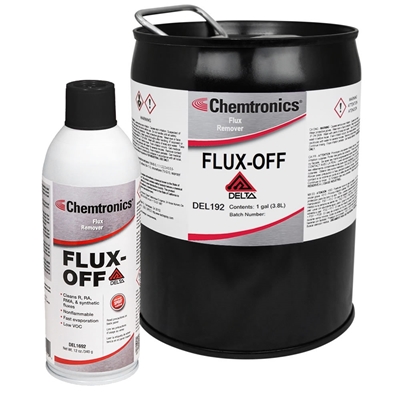
- Electro-Wash Delta and Flux-Off Delta Precision Cleaners: Extra strength, nonflammable solvents that evaporate quickly without leaving residue and feature low VOC and GWP for regulatory compliance.
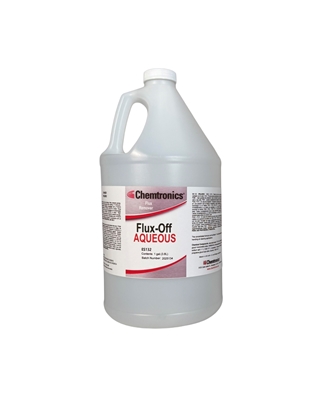
- Flux-Off Aqueous: Extra-strength water-based cleaner for all rosin and no-clean flux types. It can be diluted 1:10 with deionized water to reduce cost and environmental impact.
Frequently Asked Questions (FAQs)
Q: How does ultrasonic cleaning equipment work?
A: An ultrasonic cleaning process utilizes equipment to transmit ultrasound waves, generally between 20-40 kHZ. The transducers send sound waves through the liquid cleaner, which acts as a transfer medium from the transducers to the parts. At very high frequencies, acoustic streaming occurs, while lower frequencies create cavitation within the liquid. These voids quickly collapse, generating heat and shock waves that create agitation in the cleaning process.
Q: Are there disadvantages to ultrasonic cleaning?
A: Yes, ultrasonic cleaning has the potential to cause damage to delicate parts and surfaces, particularly ceramic-based electronics and MEMS components like gyroscopes or microphones. Another potential problem is cross-contamination, which happens when broken down soil contaminates the solvent and redeposits onto the next parts being cleaned.
Q: How can I quickly test a solvent's solvency power?
A: Place a drop of cleaner directly on the soiled part, let it sit for a few minutes, and then blot it dry. From this simple test, you can generally tell if the chemistry is a good match to the soil. If the cleaner just sits on the surface of the soil, and doesn’t wet and start to break down the soil, move on to the next cleaner.
Q: Does solvent density affect ultrasonic cleaning?
A: Yes, density can have a minor impact on how quickly the sonic waves travel through the liquid, and the amount of cavitation. A higher density material requires more energy to move, so it could deplete the energy, and thus the cleaning power, by the time it reaches the part.
Need Help? Chemtronics's lab is available to help you qualify products, establish cleaning procedures, or diagnosing cleaning issues. For more information, write to [email protected] or call 770-424-4888.
Ask A Technical Question
Stay up-to-date on Chemtronics news, products, videos & more.
Related Products