


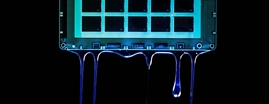
What solvent can I use to thin this conformal coating?
Heptane, Toluene, or Acetone can be used as a thinning agent. Make sure it is anhydrous, so contains as little moisture as possible.
Read This Post

What Is the Best Cleaning Solvent for an Ultrasonic Process?
If the chemistry is a good solvency match to the soil, less sonic agitation will be needed. This allows you to run your cleaning process more quickly, at lower temperature, and lower amplitude, decreasing the likelihood of damaging sensitive...
Read This Post

How Do You Maximize Cleaning Performance with Ultrasonic Equipment?
Several adjustments can be made to increase the cleaning performance of your ultrasonic process: Frequency – This is the number of waves in a second, so how “tight” the wave form is. Lower frequencies provide more aggressive...
Read This Post

How Does Ultrasonic Equipment Work?
An ultrasonic cleaning process utilizes equipment to transmit ultrasound waves, generally between 20-40 kHZ. The transducers send those sound waves through the liquid cleaner, which acts as a transfer medium from the transducers to the parts....
Read This Post
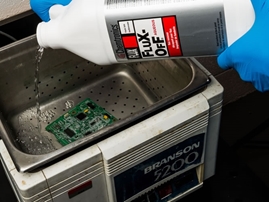
Ultrasonic Cleaning: The Ultimate Guide
Ultrasonic cleaning equipment used with a solvent is a popular choice when companies in heavy industry, electronics, medical electronics, and aerospace industries need to aggressively remove stubborn soils. An ultrasonic cleaning process utilizes...
Read This Post
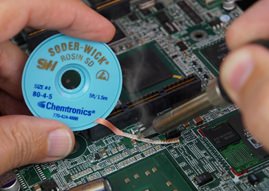
Soder-Wick User's Guide
Wick, Solder Wick, Desoldering Wick, Solder Braid, Desoldering Braid. All of these names refer to the same thing. It is a method of removing unwanted solder using flux and braided copper wire. It is commonly used to aid in removing faulty...
Read This Post

Which wipe is best with aggressive solvents?
Solvent compatibility is another factor to consider when choosing a wipe. If the wipe is to be used with a solvent in the cleaning application, then the wipe must be selected with the solvent in mind. Solvent retention and absorbency may also...
Read This Post

What wipe is best for rough surfaces?
Any wipe will produce particulates depending on the amount of abrasion it receives in use, so abrasion resistance should be considered. Wipes usually release the most particulates from their edges, so using a sealed-edge wipe will greatly reduce...
Read This Post
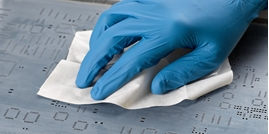
Which wipe is best for general cleaning?
Chemtronics general purpose wipes are meant to be used for wiping and in non-critical or controlled environments. By cleanroom standards, Chemtronics general purpose wipes would be acceptable in Class 10,000 cleanrooms or in “controlled...
Read This Post

What type of wipe is best for cleanrooms?
Cleanroom wipes used for critical applications are almost always knitted synthetic fibers. Knitted polyester fabric, like used for Coventry Poly-Wipes (part #6209), is the most popular wipe material for cleanrooms. Knitted polyester is made...
Read This Post
New Products
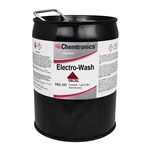
Electro-Wash Delta Cleaner Degreaser
Extra-strength, nonflammable electronic cleaner and degreaser
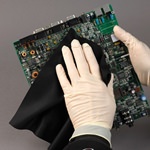
Coventry Poly Double-Onyx ESD Wipes
ESD safe, black polyester monofilament wipe