


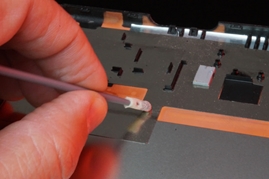
Can Conductive Paint be thinned?
If a thinner coating is required, conductive ink can be thinned using butyl acetate solvent. Using other solvents to thin the conductive ink is not recommended, as they may change the properties of the acrylic polymer or force the polymer out...
Read This Post
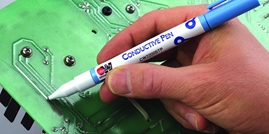
Can I solder directly onto a drawn trace?
A trace drawn with the conductive ink will combine with solder, provided the soldering temperature does not exceed 350°F (177°C) and the solder joint is formed within 5 seconds. If the drawn trace must be soldered to, we recommended...
Read This Post
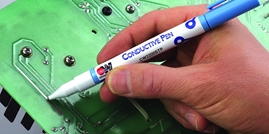
How do I prepare the surface for trace repair?
For optimal adhesion to most surfaces, clean the repair area prior to ink application. That insures the surface is free of oil, greases and handling soils. For precise cleaning just around the rework area, Chemtronics offers CircuitWorks Flux...
Read This Post
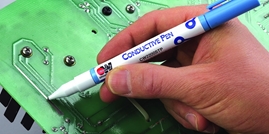
How do I unclog a conductive pen?
If you experience difficulty in producing a smooth flow of conductive ink, this could indicate clogging of the product outflow channel within the tip assembly. As the pen sits in storage, especially if stored tip downward, the suspended silver...
Read This Post
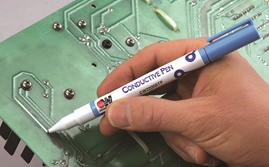
Conductive Pen Tips and Tricks for Best Performance
CircuitWorks Conductive Pens have a wide range of uses, from drawing traces between components on prototype circuit boards, coating components and assemblies to shield them from electrical and radio frequency interference, to repairing broken...
Read This Post

How do you apply liquid conformal coating? (CTSR-X, CTLED)
Apply to clean, moisture-free surface. Areas not requiring coating should be masked. Application: Coating may be applied by spraying, brushing, dipping or flow coating. Allow coating to flow around components. Cure: Room temperature cure:...
Read This Post

How do you apply liquid conformal coating? (CTSR)
Apply to clean, moisture-free surface. Areas not requiring coating should be masked. Application: Coating may be applied by spraying, brushing, dipping or flow coating. Allow coating to flow around components. Cure: Room temperature cure:...
Read This Post

How do you use an aerosol conformal coating? (CTSR-12)
Shake well. SURFACE MUST BE CLEAN & MOISTURE FREE. Areas not requiring coating should be masked. Coating: Spray top to bottom, allowing coating to flow around components. Rotate board 90˚ and repeat process 2 or more times. If nozzle clogs,...
Read This Post

How do you apply liquid conformal coating? (CTAR)
Apply to clean, moisture-free surface. Areas not requiring coating should be masked. Application: Coating may be applied by spraying, brushing, dipping or flow coating. Allow coating to flow around components. Cure: Room temperature cure:...
Read This Post

How do you use an aerosol conformal coating? (CTAR-12)
Shake well. SURFACE MUST BE CLEAN & MOISTURE FREE. Areas not requiring coating should be masked. Coating: Spray top to bottom, allowing coating to flow around components. Rotate board 90˚ and repeat process 2 or more times. If nozzle clogs,...
Read This Post
New Products
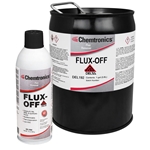
Flux-Off Delta
Extra strength, nonflammable solvent that removes heavy and encrusted flux deposits

FOCCUS CCT Clear Connection Tool
Easy to use tool for fast and effective end-face cleaning of fiber connectors