Ultimate Guide to Temporary Solder Mask
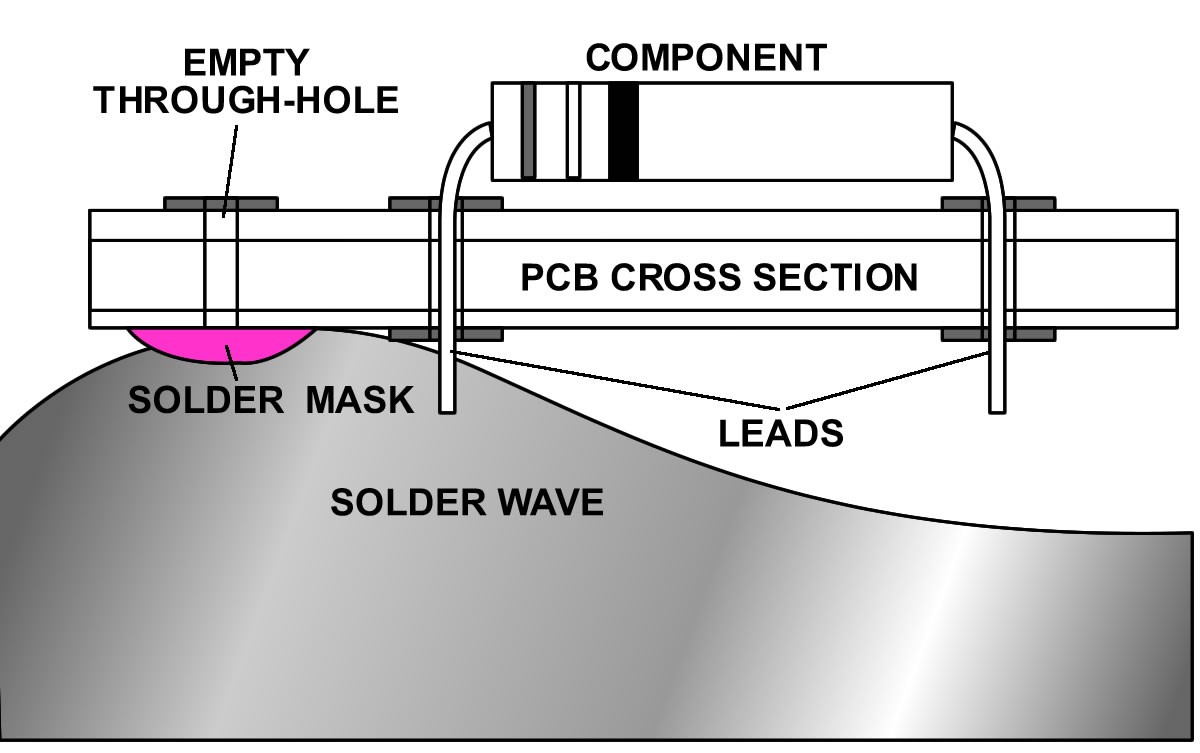
Temporary solder mask (also called "spot mask") is used every day in the assembly of electronic circuit boards. Solder mask is engineered to protect thru-holes or "vias" in wave soldering. It has to withstand extreme soldering temperatures and still be removed easily and efficiently at the end of the PCB assembly process.
If you are spraying or dipping conformal coating, mask can be used to protect connectors and other areas that can't be coated. Not to be confused with "permanent" solder mask, commonly known as solder resist, temporary solder mask is engineered to be removed. Temporary solder mask is an essential tool for automated soldering processes.
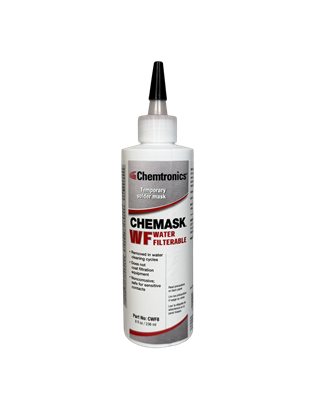
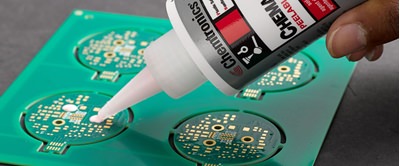
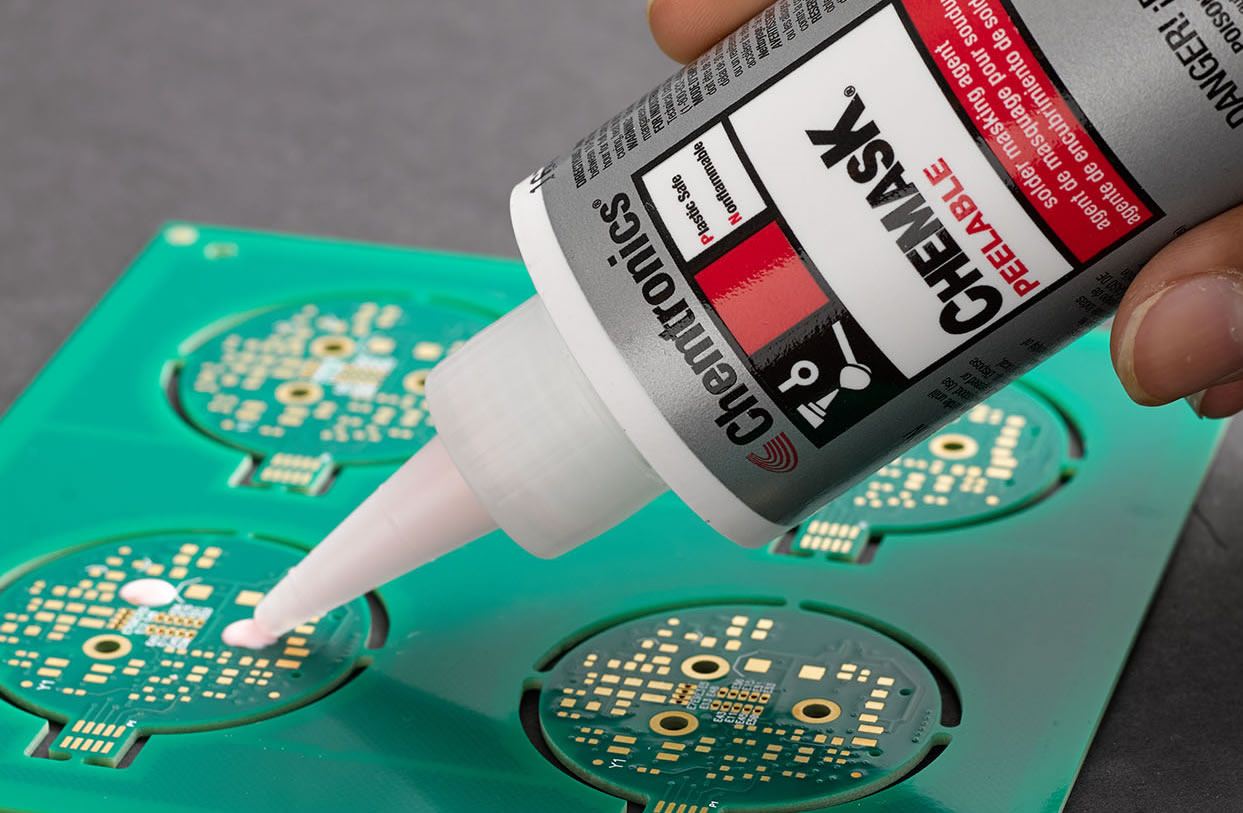
Chemask® Solder Mask products protect PC boards, plated thru-holes, contacts, pins, posts, terminals and gold fingers during wave soldering. They provide short-term high-temperature protection from molten solder. All Chemtronics solder masks are nonflammable, non-contaminating and will not leave ionic or corrosive residue. Chemask® Solder Masks are available in convenient squeeze bottles for a precision manual application or in gallons for automated applications.
6 Common Uses for Temporary Solder Mask
- Masking open PCB thru-holes in wave soldering process: This is the most common use for spot mask. Circuit boards are often designed to work within multiple different product models, so different feature sets may require some areas to be populated and others unpopulated. To make sure these open vias stay open (and not soldered in the wave soldering process) mask is applied over the open areas. The wave soldering process isn't discriminating, and will solder anything that is metal and fluxed. Solder will not stick to mask, however, so the area underneath will be unaffected.
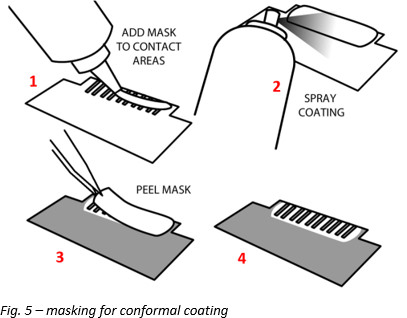
- Masking contact areas or solvent-sensitive components: When applying conformal coating to a circuit board, it is important to avoid contact areas. Coatings are generally insulative, so will impede the function of contacts, switches, and anything that relies on metal-to-metal contact. Components that are solvent-sensitive or which have moving elements may also need to be masked. This is less necessary in selective spray systems, but if applying coating from an aerosol can, or through a hand sprayer or dipping process, masking is often required.
- Damming around low stand-off components: SMT (surface mount technology) and BGA (ball grid array) components often have very low stand-off areas-- the space between the component and the surface of the board. Even when applying conformal coating with a selective spray system, you run the risk of material being drawn beneath the component through capillary action. For some designs, this may be problematic, and one solution is to mask surrounding the component to create a dam.
- Temporary adhesive for soldering double-sided SMT PCBs: A significant challenge of assembling double-sided SMT circuit boards is how to solder components on the bottom-side of the board. Running the top-side of the board through the reflow oven isn't a problem because gravity helps hold the components in place as the solder melts and then solidifies. When the board is flipped to run the bottom side though, you are counting on the surface tension of the solder to hold components in place. Although that may work for smaller components, larger components and BGA corners may need spot mask as an adhesive.
- Protecting temperature sensitive-components in the reflow process: Because latex mask is thermally insulative, creative engineers use it to protect heat-sensitive components in the reflow process. However, since this goes far beyond the intended purpose of temporary solder mask, solder mask manufacturers will probably be of little help qualifying the product for this application.
- Masking areas in painting, powder coating, or plating process: If you picture temporary solder mask as liquid masking tape, it opens up a world of potential applications. Again, it is well outside the intended purpose, so you will need to test and qualify for yourself.
Application Methods for Temporary Solder Mask
The main methods to apply temporary solder mask are by hand (with a squeeze bottle or tube), with a pneumatic system, or stenciled.
| Application Method | Process & Best Practices | Potential Pitfalls to Avoid |
| Manual / Hand Application | Squeeze the bottle to apply mask to the areas that need protection. Hold the bottle at 60° to have precise and light placement, with a bead thick enough to prevent breakage during removal. | Many operators hold the bottle at a 90° angle as they drag the dispensing tip across. This forces mask through vias, making it stick, mushroom out, or become hard to wash off. A 90° angle also creates a thin bead that is likely to break during removal. |
 |
||
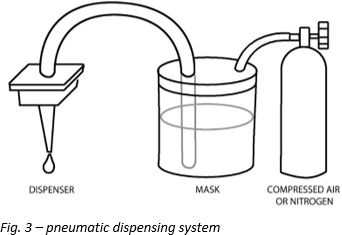
| Pneumatic Dispensing | The mask is pressurized with either compressed air or nitrogen and forced out of a dispensing tip or needle. Pressurizing with nitrogen can help alleviate mask skinning. Most solder masks can be thinned with DI (deionized) water to reach the optimal viscosity. | Take care that you use a mask with a low shear cure; high shear curing mask experiences accelerated curing when pressure is applied, clogging the tip. Skinning in the tank can also cause clogs. Mix thinner carefully to avoid whipping air bubbles into the mix. |
 |
||
| Stencil Printing | Mask can be applied with a stencil in a similar process as printing solder paste in a surface mount assembly process. This process is only feasible when there is a flat surface. | Ensure viscosity is high enough to be controlled and not drawn beneath the stencil through capillary action. Screen printing should be avoided with very fine mesh screens because of the cleaning challenges. |
  |
||
How to Select the Best Temporary Solder Mask
There are several factors to consider when selecting a solder mask:
1. Removal Method
The first decision when selecting a solder mask is the last step-- how it will be removed.
- Water-Washable: If you currently run your PCBs through a batch or in-line wash system, you have the option to use a water-washable mask. Chemask® WF Solder Masking Agent can be removed in a batch or in-line cleaning system, and will not clog filters or damage ion filter beds. It is a high-temperature temporary spot mask that is water soluble, low foaming, and stable to rosin, organic and inorganic fluxes.
- Peelable: If you use solvent cleaners, or don't clean your boards at all, peelable masks are your best option. Peelable solder masks are commonly used in no-clean soldering environments or by PCB assemblers that clean with solvents. They are commonly used for masking contact areas and over chemically-sensitive components in conformal coating processes.
2. Sensitive Metals
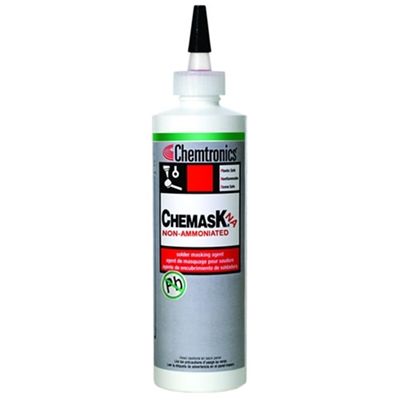
Chemask® Non-Ammoniated Solder Masking Agent is a latex, ammonia-free, fast curing, peelable temporary spot mask formulated for safe use on sensitive metals. It has low odor and is safest on sensitive metals like copper. It contains high-temperature resistant compounds that protect component-free areas during wave soldering, and may be used to protect pins, posts, contacts and edge connections in the solder reflow oven or during conformal coating processes.
3. Masking for Conformal Coating
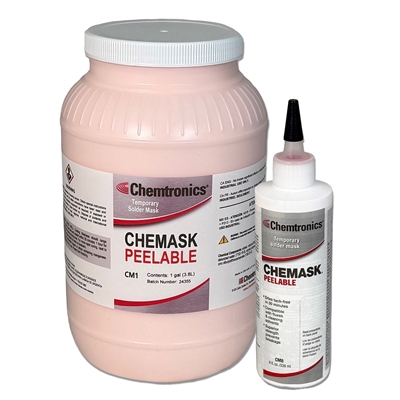
Chemask® Peelable, our best-selling mask, is ideal for masking areas from conformal coating. It is a fast-curing peelable solder masking agent containing natural latex formulated with high-temperature resistant compounds.
4. Masking Large Vias
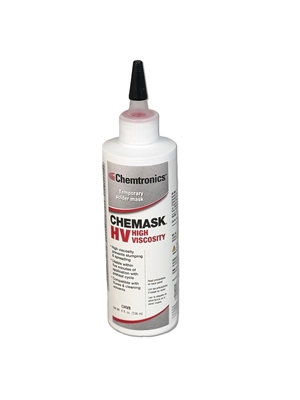
Chemask® HV Solder Masking Agent is a temporary, high viscosity, fast curing, peelable solder masking agent that works well for masking large vias. It can be introduced to the wave solder preheat within four minutes without adverse effects.
Frequently Asked Questions (FAQs)
Q: Why should I use spot mask instead of Kapton tape or a masking boot?
A: The main advantage of solder mask over these other methods is flexibility. Polyimide tape (like Kapton) generally comes in rolls or die-cut shapes, which may work perfectly for most areas, but there are always special circumstances. In addition, the adhesive on tape can leave residue behind that can create wetting issues for conformal coating. Masking boots are preformed, which requires more planning and lead time. Boots also need to be cleaned or discarded, increasing costs.
Q: How do you use temporary solder mask for conformal coating?
A: If you think of spot mask as basically liquid masking tape, the application process becomes more intuitive:
- Apply the mask to the contact areas to protect. Allow the mask to fully cure.
- Apply the conformal coating.
- After the coating is dry to the touch, but before it is fully cured, peel off the mask. For the cleanest masked edge, peel the mask before the coating is fully cured, otherwise it could create a cracked, ragged edge, or even pull up the coating. Note: Peelable, natural latex mask is recommended because conformal coating is generally hydrophobic (hard to wash under) and synthetic masks can interact with harsh coating solvents.
Q: How do you remove spot mask?
A: Peelable mask is usually removed by hand or with tweezers. Washable mask is engineered to be removed in an aqueous inline or batch wash system. If you are using a closed-loop system, make sure you use a mask that is compatible with your physical filters and ion beds. If you experience foaming, replace your wash water with fresh DI water, or add a defoaming agent as a stopgap.
Q: Can solder mask be left on the circuit board?
A: Temporary solder mask is intended to be just that - temporary. Manufacturers always recommend removing the mask because there is no testing to support doing otherwise. If you decide to leave it on, you will have to do your own functional and reliability testing.
Q: How long should I cure temporary solder mask?
A: Mask cures from the outside-in, so it skins over, and then cures on the inside. This can take anywhere from 30 minutes to 24 hours depending on the type of mask and the thickness of the bead. The mask may not need to be fully cured when it is put on the wave conveyor, but it should be cured to the touch with a firm skin. If uncured mask hits molten solder, the liquid element instantly vaporizes and will forcefully exit, creating voids or throwing solder beads all over the PCB.
Q: How high of a temperature can temporary solder mask withstand?
A: Most commercially available masks should be able to withstand melting point temperatures of lead-based and lead-free solder, up to 650°F (343°C) for the brief time it is exposed in a typical wave soldering process.
Q: Can spot mask run through SMT reflow?
A: Yes, but it is exposed to extreme temperatures for a longer period of time compared to wave solder, increasing the risk the mask will bubble, char, and become brittle. Natural latex is generally recommended for reflow. Synthetic materials tend to become brittle, and washable masks will be very difficult to remove.
Need Help? Contact us at 770-424-4888 or [email protected] and we can help you find the best temporary solder mask for your requirements.
Ask A Technical Question
Stay up-to-date on Chemtronics news, products, videos & more.
Related Products