Ultimate Guide to Contact Cleaners
If you're getting intermittent issues with your device, you likely have contamination in the electrical contacts. A contact cleaner (also called electrical cleaner, switch cleaner, electrical contact cleaner, and, specific to automotive repair, battery terminal cleaner) is a solvent cleaner designed to remove contamination from electrical contacts, the conductive surfaces of connectors, switches and other electrical and electronic components with moving surface contacts.
Dust, dirt, grease, and oxidation contamination can increase electrical resistance in contact areas. That means the current flow is potentially reduced or interrupted, affecting the performance of the device and potentially leading to safety hazards (i.e. areas with high resistance can start to heat up, or conductive contamination can create a short). Any contamination in the contact area compounds the connectivity challenges already present from the resistivity of any surface oxidation and the limited contact area.
The goal of a contact cleaner is to quickly remove insulative contamination as quickly as possible, avoiding a lot of wiping and scrubbing if possible. Contact cleaning solvents usually come in pressurized aerosol packaging for convenience and to provide a forceful spray that creates agitation and reaches into all the crevices of the connectors.
What to Look for When Selecting a Contact Cleaner
Like when selecting any other product, there are options and trade-offs to consider. It’s tempting to jump right to the lowest-priced product, but there are a number of other factors that can have a big impact on performance and safety:
| Selection Criteria | What to Consider | Best Practices & Safety |
|---|---|---|
| Flammability | Many commercially available contact cleaners contain alcohols and hydrocarbon solvents which are very flammable. | Nonflammable contact cleaners are available to avoid safety hazards without proper ventilation, or if there are open flames, sparks, or hot surfaces nearby. |
| Dielectric Strength | Dielectric strength is defined as the maximum electric field that the material can withstand before its insulating properties break down. | The lower the dielectric strength, the more likely it will break down and allow electricity to flow through it. Look for a cleaner with a dielectric strength above 30 kV (30,000 volts) if cleaning near live power. |
| Plastic & Rubber Compatibility | If the solvent is incompatible with plastic housings, it can craze (create small cracks), embrittle, or soften the material. Rubber seals may swell, shrink or even dissolve. | Alcohol and hydrocarbon-based solvents tend to be better on sensitive plastics. Always test a new cleaner before being used extensively on expensive equipment. |
| Toxicity | N-Propyl Bromide (nPB), Trichloroethylene (TCE) and Perchloroethylene (Perc) are toxic chemicals commonly used to provide nonflammable cleaning. | Avoid these solvents; workers have suffered headaches, dizziness, loss of body control, and they are linked to reproductive problems and cancer. |
| Environmental Issues | Ozone depletion from CFCs and HCFCs largely a past concern in North America, but volatile organic compounds (VOCs) and high global warming potential (GWP) are modern issues. | Some state (e.g. CARB), municipal, and industry-specific regulations restrict the use of high VOC or high GWP materials. |
Removing Oxidation, Rust, and Improving Continuity
To improve the connection quality of an electrical contact or switch, you can remove oxidation or rust either mechanically and/or chemically. A brass or steel brush is the most common method of scrubbing off oxidation, although for sensitive contacts nylon is often used. On the mild chemical side, an acid like vinegar can be used, and other agents may work for battery terminal cleaning, such as baking soda. Regardless of the cleaning material, it must be rinsed off, as a cleaner strong enough to remove rust could continue to work on unintended metal surfaces.
To prevent oxidation and improve electrical continuity moving forward, specialized products are available:
- Chemtronics DPL (Deep Penetrating Lubricant): Contains an oil additive which provides a thin layer of protection from rust-causing oxygen and moisture. It can be used to remove existing moisture and prevent oxidation.
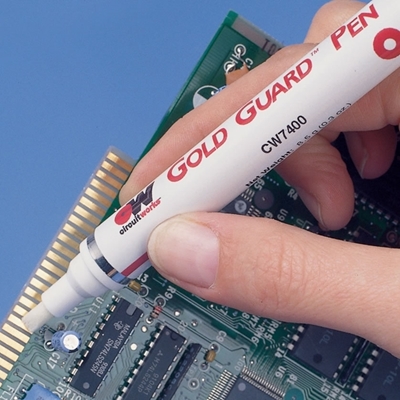
- CircuitWorks® Gold Guard™ Pen: Engineered to clean, lubricate and protect gold, silver, platinum and other precious metal contacts. The Gold Guard lubricant offers protection from oxidation and corrosion while improving contact and conductivity.
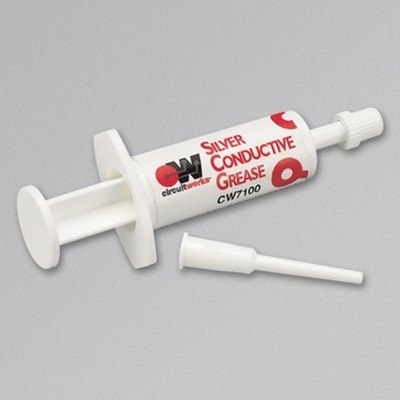
- CircuitWorks® Silver Conductive Grease: Utilizes an advanced silicone lubricant that is compatible with metal, rubber, and plastic to provide an electrically conductive barrier. Use it to fill connector gaps, provide grounding for circuits, control static discharge, and protect from moisture and oxidation while maximizing electrical conductivity.
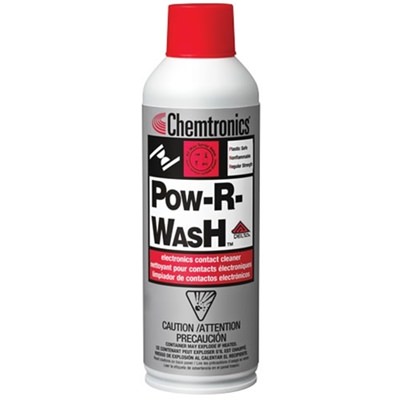
Chemtronics Pow-R-Wash™ Contact Cleaners
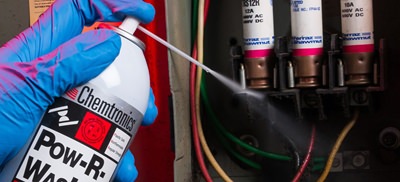
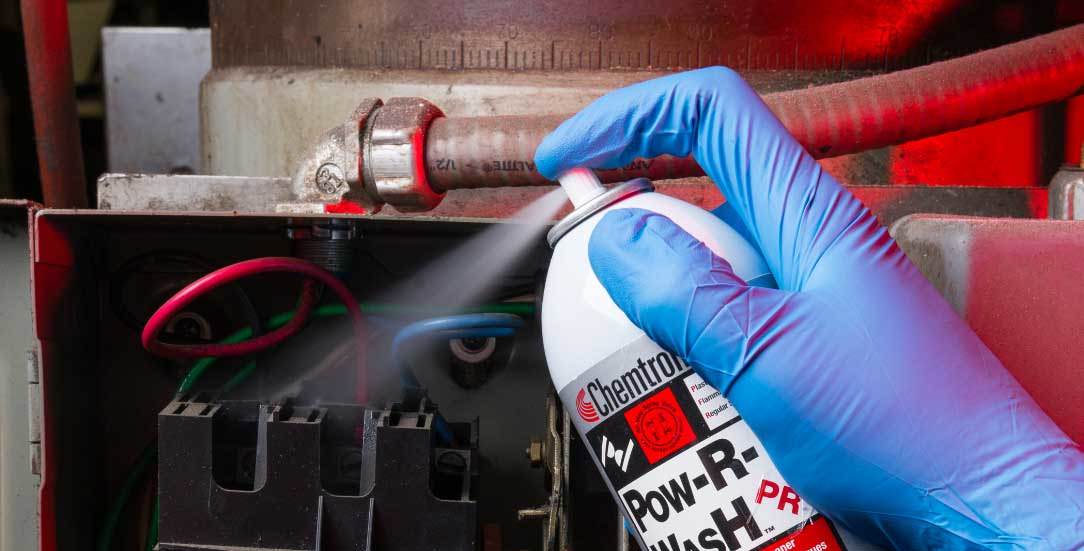
Chemtronics offers a large selection of aerosol electrical contact cleaners under the Pow-R-Wash™ brand, which range from economical heavy-industry cleaners to high precision solvents for sensitive components.
Key Benefits of the Pow-R-Wash Line:
- Safe Toxicity Levels: No Chemtronics Pow-R-Wash™ contact cleaners contain highly toxic solvents like nPB, TCE, and Perc.
- All-Way Spray: Chemtronics Pow-R-Wash™ contact cleaners have an All-Way spray, providing the option to turn the can as needed when spraying, so you are able to clean even confined or awkwardly spaced areas without spraying propellant instead of solvent.
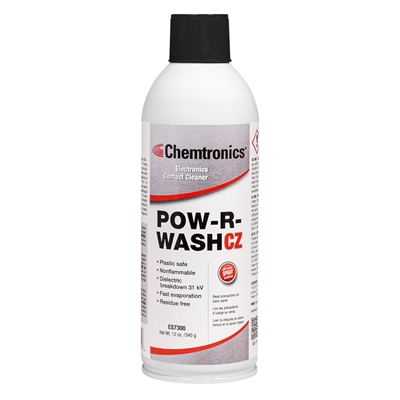
- Environmentally Conscious: Our products are non-ozone depleting making them safer for the environment. If low-VOC is the goal, Pow-R-Wash™ Delta, Pow-R-Wash VZ, and Pow-R-Wash CZ are all great options to consider.
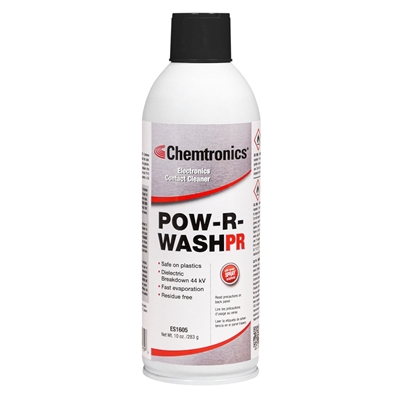
- Nonflammable Options: Chemtronics has several nonflammable contact cleaners available, including Pow-R-Wash™ VZ, Pow-R-Wash CZ, Pow-R-Wash Delta, and Pow-R-Wash PR.
Frequently Asked Questions (FAQs)
Q: Do I need to shut off power before cleaning contacts?
A: BEFORE you start spraying, we strongly recommend you shut down power to avoid the potential for sparks, electrical shorts or discharges, and other safety hazards. If, for whatever reason, you don’t have the option of disconnecting the power, look for electrical contact cleaners with a dielectric strength above 30 kV (30,000 volts). Choosing a nonflammable cleaner would also add a layer of safety in case there is a spark.
Q: What does “high flash” or “flash point” mean?
A: High flashpoint solvents still support combustion but the vapors will not combust in normal ambient temperatures (say below 140°F/60°C). High flash point contact cleaners are generally chosen because they have a relatively low cost and considered safer to use in normal operating conditions compared to highly flammable solvents. Be aware that high flash cleaners commonly contain terpene-based solvents and/or citrus-based d-limonene solvents, which have extremely slow evaporation. While an alcohol-based solvent might fully evaporate out of a connector in minutes, a high flash solvent could take hours.
Q: How do I know if my contact cleaner is flammable or toxic?
A: The quickest and easiest method of identifying a potential concern is the GHS (Global Harmonized System) pictograms. Unless an aerosol contact cleaner is able to pass a very stringent test (spraying the solvent cleaner into a drum with a candle for 5 minutes), it must have the flammable pictogram on the label. If you see the chronic toxicity pictogram (diamond containing person with exploding chest), that means the product contains something that can cause long-term effects. The acute toxicity pictogram (diamond containing skull and cross bones) means the product can have a short-term health impact. Always check the safety Data Sheet (SDS) carefully if you see these symbols.
Q: Why is N-Propyl Bromide (nPB) dangerous?
A: Comparable to TCE, Perc, and Methyl toluene, nPB has been determined by NTP as “reasonably anticipated to be a human carcinogen.” While federal agencies have been slow in regulating nPB, CA OEHHA has a REL of 5ppm and listed it as a developmental/reproductive toxicant under Prop 65. ACGIH has listed the TLV for nPB as 10 ppm, but there is a proposal to decrease it to 0.1 ppm.
Q: Are there cleaners that are safe on plastic connectors?
A: Rigid plastics like ABS, polycarbonate (trade name Lexan), and acrylic materials like Plexiglass can be very sensitive to harsh solvents like toluene, xylene, and acetone. Alcohol and hydrocarbon-based solvents tend to be better on sensitive plastics. If you do have very sensitive materials to clean and need a nonflammable solvent, Chemtronics offers Pow-R-Wash CZ for the best material compatibility.
Q: Why shouldn’t I use consumer-grade contact cleaners?
A: If you use a low-cost consumer-grade contact cleaner, such as those found in a hardware or auto parts stores, you need to be particularly careful. Many of these products use propellants like propane and butane – yes, the same material used by your gas grill or lighter.
Check out the Chemtronics contact cleaner selection guide to find the perfect fit for your application. For samples or technical help, email [email protected] or call 770-424-4888.
Ask A Technical Question
Stay up-to-date on Chemtronics news, products, videos & more.
Related Products